



Staying curious is key to the scientific method. It comes naturally to Deborah Hall, MD, PhD, the Parkinson’s Foundation Chair of Neurological Sciences and director of the Rush Parkinson’s Disease and Movement Disorders Program.
Chief among her curiosities is one prevailing question: Can we find a cure?
Early career: Forming the hypothesis
From her high school years, Dr. Hall was interested in using science to help others. Alzheimer’s disease runs in her family, and as she witnessed family members get diagnosed, she became interested in the brain and the biology of disease. She double majored in biology and chemistry at Indiana University and went on to pursue and obtain her medical degree from IU.
“I was pretty excited about anything science-related,” she said. “I applied early decision to medical school and was accepted before I began my senior year of undergrad.”
While the decision to study medicine was easy, choosing a specialty took some trial and error. No stranger to the scientific process, Dr. Hall learned something about herself each step of the way. She explored interests in family medicine and parasitology and eventually found the right fit during her neurology rotation in her third year of medical school.
“It was at an outpatient clinic in movement disorders,” she said. “I walked into the waiting room, and I knew this was what I was going to do. I never wavered after that.”
Toward the end of Dr. Hall’s residency at the University of Colorado Health Sciences Center, a mentor was involved in the discovery of Fragile X-associated tremor/ataxia syndrome, or FXTAS, and asked her to work on a project related to it.
“I just fell in love with research,” Dr. Hall said. “I love that you would ask a question, do a project and then get the answer. I enjoyed the beginning, middle and end.”
Soon after, Dr. Hall’s mentor encouraged her to apply for a research fellowship. She wrote 10 applications, and one was accepted by the American Academy of Neurology. In tandem, she pursued a PhD in clinical investigation with help from one of the National Institutes of Health’s, or NIH’s, Loan Repayment Programs, which aim to recruit professionals into biomedical or biobehavioral research careers by repaying educational debt in exchange for engagement in NIH research.
Dr. Hall balanced her research and educational work with her time as an attending physician, being on call for two weeks at a time. The hard work paid off when she applied for and received a highly competitive K23 Mentored Patient-Oriented Research Career Development Award from the NIH.
“The K23 award really jump-started my career,” she said. “It kind of feels like you’re winning the lottery. No one is going to just hand it to you. You have to go out and get it.”
Mid-career: Testing and experimenting
Over Dr. Hall’s career, she has focused on defining the clinical features of Fragile X-associated disorders and how those features are measured.
“I was there when the disease was discovered, and now we may be getting ready for gene therapy,” she said. “I’ve been able to watch this whole trajectory. The most recent NIH grants I’ve gotten are to examine: Now that we know what the disease is, how do we fix it? These grants are preparing us for clinical trials.”
Dr. Hall is also known for her research in Huntington’s disease. She began working with patients diagnosed with the disease about 20 years ago, when there was little research available about it. “You would diagnose the patient and prepare the family,” Dr. Hall said. “It’s a fatal neurodegenerative disease.”
But the advancement of gene therapies resulted in a major breakthrough. In September 2025, the results of a clinical trial of the AMT-130 infusion showed that the therapy proved to significantly slow the progression of Huntington’s disease. This is the first discovery of its kind in a movement disorder, and Rush is one of 12 U.S. sites for this clinical trial.
“We can thank our colleagues in the labs, developing the technology, that we may be looking at slowing down the progression of the disease,” Dr. Hall said. “And wouldn’t it be great if we could treat people who are gene-positive but have no symptoms yet? Can we actually prevent the disease?”
While there are many growth paths in academic medicine, Dr. Hall’s passion lies in curing disease. This impetus fuels her approach to her patient care and the questions she asks.
“It is really important to me to be in the clinic and develop relationships with people that I continue over time,” she said. “I learn from them what we need to try to fix in the lab. It’s motivating to have a patient say, ‘You need to go figure this out.’”
That exact scenario opened Dr. Hall’s eyes to racial disparities in movement disorders. A patient asked what, specifically, she and the field were doing to help Black patients. That was the catalyst for a large, multisite, NIH-funded project to define Parkinson’s disease characteristics and genetic risk factors in Black patients. It is the largest Parkinson’s study to be conducted in this patient population.
Dr. Hall takes the ideas she gathers from treating patients in the clinic and shares them with her colleagues in the laboratory. She then uses the answers to advance the care she provides. This is bench-to-bedside research — a hallmark of Rush and what drew Dr. Hall here in 2009.
Leadership: Analyzing results and drawing conclusions
As director of Rush’s Parkinson’s Disease and Movement Disorders Program, Dr. Hall is laser-focused on impact. She prioritizes helping as many people as possible by focusing on conducting research that can scale and providing mentorship to the faculty around her.
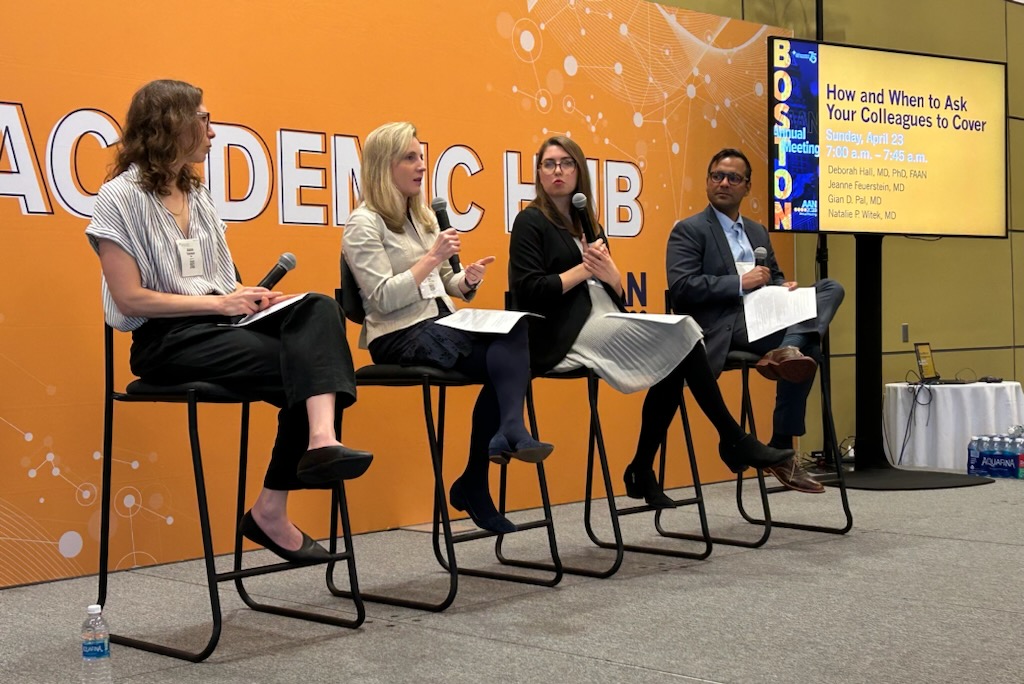 “I recruited Dr. Hall because I saw her early success and her potential for scientific and administrative leadership,” said Christopher G. Goetz, MD, past director of the Rush Parkinson’s Disease and Movement Disorders Program. “Passing the baton of leadership to her has been one of the great privileges of my career.”
Over her career, Dr. Hall has served as a mentor, coach and advocate for hundreds of her colleagues. Her experience applying for grants and reviewing research projects on the Rush Institutional Review Board and study sections for the NIH and Department of Defense has positioned her well to help others.
She runs K Club in the Department of Neurological Sciences — a group of faculty peers who give each other feedback on research applications before submission to the NIH and other public and private sources. Many successfully funded Rush movement disorders researchers, like Alana Kirby, MD, PhD; Jori Fleisher, MD, MSCE, FAAN; and Joan O’Keefe, PT, PhD, went through K Club.
“I have learned a lot about the nuts and bolts of academic neurology from my conversations with Dr. Hall,” Dr. Kirby said. “She has helped me to determine my strategic priorities as I build my career, introduced me to senior research and clinical leaders and recommended me for valuable career-building opportunities.
“Beyond her impact on me, I see her consistently showing up to mentor and advise junior scientists. She excels at practical support, and I am incredibly fortunate to have her as my division chief.”
Looking ahead, Dr. Hall aims to build on the momentum of scientific advancements in gene therapy, microRNA technology and stem cell technology to advance the department’s gene therapy research and expertise in personalized genetic medicine.
Longer term, Dr. Hall hopes she and her team can answer that guiding question: Can we find a cure?
“And wouldn’t it be great if it was for Parkinson’s?” she said. “But I would take any of the movement disorders we treat because I think if we can fix one of them, we can learn for the rest of them.
“Even if I gave just a little piece of the puzzle to get it fixed, I would be happy with that. If I can help people who are suffering, that would be a good career to me.”
The importance of philanthropy
Uncertainty in federal funding for biomedical research is creating real challenges across academic medicine, including at Rush. Without sustained support, promising scientific ideas stall before they can be tested. And without funding, early-career faculty may struggle to begin careers in research.
“This is the most critical time I’ve ever seen for philanthropy,” Dr. Hall said. “There’s never been a time when we needed to rely as much on our philanthropic partners. We want to get to a cure, and we can’t lose the faculty who have the new and big ideas that move the field forward.”
Dr. Hall’s own research career was launched with an NIH Career Development Award. Faculty who receive these awards are more likely to secure additional public and private funding, helping them build impactful research programs. When opportunities for these awards dwindle, academic medicine becomes a less viable path, especially for investigators pursuing high-risk, high-reward ideas that traditionally have relied on NIH support.
“I may not be a researcher if I hadn’t gotten one of those awards because I wouldn’t have had protected time for it,” Dr. Hall said. “You just cannot be a researcher while seeing patients 100 percent of the time. It’s not possible.”


