



Rush University’s Men in Nursing brought home hardware for the third consecutive year and fourth time overall at the American Association for Men in Nursing conference.
The group earned the “Best School for Men in Nursing” award for Rush, demonstrating its ongoing commitment to representation and recruitment of men in the health care workforce.
Rooted in Mentorship
Luther Christman, PhD, RN, founding dean of the College of Nursing, was the first male dean of an American nursing college and played a large part in the creation of the American Association for Men in Nursing.
Aaron Franklin, DNP, RN, Men in Nursing faculty advisor, says Christman was no stranger to the challenges male nurses face.
“He was a big advocate for men going back to pursue doctorate degrees. But he has a long history of being refused from going into his clinicals, like labor, delivery and others,” Franklin says.
Christman laid the foundation for future advocacy and mentorship opportunities for male nurses at Rush.
Revitalizing Men in Nursing
Franklin did not see people who looked like him in leadership roles as he was going through school or life. That was until he was hired by Fred Brown, DNP, RN, chair, Department of Adult Health and Gerontological Nursing, College of Nursing, more than a decade ago.
Brown’s path to nursing and eventual leadership was a nontraditional route. He began his studies as an engineering student and then found himself in the military reserves as a MedTech. He later went on to receive his master’s, bachelor’s and doctorate degrees from Rush University.
As Brown moved up in his career, Franklin followed his example and now encourages others to do the same.
“The thought of him one day retiring freaks me out because he’s always been here,” Franklin said. “We regard ourselves as ‘Big Spock’ and ‘Little Spock’ because it feels like I’m following in his footsteps.”
The mentorship between Brown and Franklin ultimately led them to the Men in Nursing group. After a faculty member asked Brown to speak with male nursing students about success in the field, he brought in practicing nurses, including Franklin, to talk with them about the challenges they faced.
Franklin saw that Men in Nursing had “fizzled,” so he decided to focus his DNP capstone project on the commitment Christman set years ago — increasing retention and recruitment of men in the nursing program.
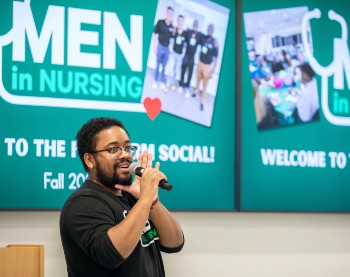
His project ultimately led to the revival of Men in Nursing at Rush University.
 The More Representation, The Better the Outcome
As Men in Nursing began to grow, Franklin focused on creating a sense of belonging for male nurses. He says many of them did not feel like they belonged in certain spaces that are predominately occupied by women.
“Imagine being on the unit with largely women. As a man, you feel out of place at times, and that’s not the case at all,” Franklin says. “We [Men in Nursing] connect and try to do things together and have conversations about different challenges or opportunities.”
Franklin says he thinks about the influence he and others in the group have on one another, including Mateo Rey, student vice president of Men in Nursing.
Rey has developed skills from the group beyond the nursing profession, including interviewing and leadership skills. In his position as an officer, he says he now gets to pay it forward to the younger class.
“I have all these people that are helping me, providing me with leadership, supervision and guidance in what I want to do. I’m trying to help people who are newer in the organization in my own way,” Rey says.
But being relatable and encouraging faces in the classroom isn’t Franklin and Rey’s only goal.
According to the American Association of Colleges of Nursing, men make up about 12% of the total number of nurses in the United States. That gap has decreased from 2020 when the percentage of men in nursing was reportedly at 9.4%.
Rey says if you can make clinicians look like the people they are caring for, you’ll get better outcomes.
“Patients who are also men, or people who share your same religion, or people who share the same race — it's just another way of being able to connect to patients and make that deeper connection so they can have a better outcome,” Rey says.
Hannah Diaz, a member of Men in Nursing, says it's also important to be part of groups that challenge what you’re used to. She says as a woman in Men in Nursing, she has been able to support and understand her male patients better.
“Just from talking with the guys in the group and with patients, it seems that men overall don’t really want to open up and express things. They don’t want to show weakness or curiosity,” Diaz says. “I feel like opening that door, asking questions and allowing them to be vulnerable, I’ve seen a change in patients being able to navigate their own care confidently.”
A Full Circle Moment
Benjamin Serrano, student president for Men in Nursing, notes their group was the largest at the American Association for Men in Nursing conference. He says it showed just how much Rush and its students care about the organization.
“It highlighted that Rush recognizes there is a small percentage of nurses who are men. That support does mean something not only for people in the field but for people who want to enter the field,” Serrano says.
Serrano and Rey were two of four students awarded the AAMN Scholarship. The ceremony reminded the Men in Nursing Group of all the work they’ve accomplished.
“They read off all our achievements, and I was like, ‘Wow, we did a lot,’” Diaz said.
As the students reflect on their achievements, Franklin reflects on the first time they went to the AAMN conference in 2022.
“It was kind of a full circle moment. Because I remember at this same award banquet, I was with our students, and we didn’t get an award. We were just watching,” Franklin says. "Now, we’re regarded as one of the best chapters.”
If you’d like to learn more about Men in Nursing at Rush, visit the group’s page here.


