



When a stubborn headache began creeping down the right side of Marion Jones’ neck in the fall of 2020, she brushed it off as the kind of discomfort anyone might feel during a stressful year. She was juggling a move, a demanding career and the isolation of the pandemic.
“It started as just a headache,” Jones said. “But after a few weeks, it migrated down my neck, and something just felt off. A friend finally told me that I needed to go to the ER.”
That visit would change the trajectory of her life. Within 72 hours, Jones was told she had neuromyelitis optica, or NMO, a rare autoimmune disease that attacks the spinal cord and optic nerves. She remembers nearly every word from the neurologist who delivered the news.
“He told me he had some news — bad news,” Jones said. “To hear that I had this autoimmune disease with no cure was devastating. But then he said something that I still hold on to: ‘We do have treatment options. And I treat people who live normal lives.’ That stayed with me. I clung to it for dear life.”
Losing control and rebuilding from nothing
The decline that followed was swift and terrifying. The numbness spread down Jones’ body. Her leg began to drag. COVID-19 restrictions meant that her family couldn’t be by her side.
“I was living in Boston, completely alone. I didn’t have family there. And overnight, my whole world came to this screeching halt,” she said. “I was in the ICU, and I had to call the company I had just accepted a new job with to tell them I couldn’t take it anymore. I had no idea what was going to happen to me.”
After a relapse caused by an initial medication that wasn’t a good match, Jones once again lost mobility.
“I remember holding a cold pack from the freezer against my leg and not feeling a thing,” she said. “And I just knew that it was a red flag. That something was really wrong.”
That night, the sensations she’d felt only on the right side migrated left. By morning, she was unable to walk.
“It was a nightmare,” Jones said.
She went on to spend months in a rehabilitation center relearning how to sit, stand and eventually take steps.
“It was like being a child learning everything all over again,” she said. “When you’re dealing with paralysis, nothing is guaranteed.”
A doctor becomes a patient
In Aurora, Illinois, another woman was unknowingly at the beginning of the same journey. Sumita Bhatia, MD, then a radiation oncologist at Rush Copley Medical Center, had just gotten engaged when she started having numbness in the bottom of her feet. 
“We were moving into a new apartment and wedding planning,” Bhatia said. “Life was full. And I knew immediately the numbness was not normal.”
Bhatia went straight to the Emergency Department at Rush Copley.
“Because I was a physician there, I trusted them,” she said. “I knew how well they cared for people. And suddenly, I was the patient needing that care.”
When her tests revealed an active lesion in her spine and, later, positive NMO antibodies, she was frightened, but she also felt something else: determination.
“I told myself, ‘Let them do everything they need to do. Put in the central lines. Do all the tests. Just fix me,’” Bhatia said.
Two women, one physician and shared hope
Both women, without yet knowing each other, soon found themselves in front of the same neurologist: Augusto Miravalle, MD, at Rush University Medical Center.
Bhatia remembers that moment vividly.
“When Dr. Miravalle walked into the room, the very first thing I sensed was compassion,” she said. “He was calm. He was knowledgeable. And he took a piece of paper, sat down and started sketching exactly what was happening in my spine. I will never forget that. He explained every medication, every side effect. He told me that I may forget that I even have NMO. As a patient, hearing that brought me peace I cannot describe.”
For Jones, who had moved across the country specifically to find long-term care, meeting Miravalle was equally profound.
“I walked into the multiple sclerosis suite at Rush, and something just felt familiar, like home,” she said. “The staff, the nurses, the way they greeted me. And then with Dr. Miravalle, he really listened. He wanted to know who I was, not just as a patient, but as a person.”
When she pulled out the meticulous notes she’d taken since diagnosis, he smiled.
“He went through my questions and answered every single one,” she said. “He made me feel like I wasn’t alone in this.”
Miravalle later introduced Jones and Bhatia, sensing how much they could help one another.
The connection was immediate.
“This deep, amazing friendship developed,” Bhatia said. “Marion has been such a huge support for me because she understands exactly what I’m going through.”
Donor-supported care that treats the whole person
Both women say one of the most important parts of their recovery came from a place they didn’t expect: Rush’s Brain Health Program, which is supported through philanthropy.
“These are difficult times to advance research and patient-centered care,” Miravalle said. “Now more than ever, we need collective support to help us promote this work and propel the research, so we can continue to understand how the interventions we provide as part of this program positively impact lives.”
For Jones, the program reinforced the holistic pillars she’d learned during rehab, including nutrition, hydration, rest and stress management. But more importantly, it offered community.
“It’s this space where everyone just gets it,” she said. “There’s education, accountability, support. They help you build a life again. And donors make that possible. They make it possible for patients like me to access resources that help us prevent relapse and stay well.”
That philosophy has shaped how she lives her life.
“For someone with a neurological autoimmune disease, fatigue is part of it,” Jones said. “I’ve had to relearn my body. Eight hours might be enough sleep for someone else, but I might need 10 and a nap on top of that. That’s not weakness. That’s fuel.”
For Bhatia, who trained in integrative medicine, the program felt like therapy, structure and empowerment all at once.
“I learned tools I use every single day,” she said. “The nutrition guidance, the exercise recommendations, the stress management. It all matters. And it changes outcomes. Truly, this program changed the way I live my life.”
Different paths, shared forward motion
Today, Jones is running marathons. What began as 30-second intervals became a mile, then several. She ran her first marathon in 2023. 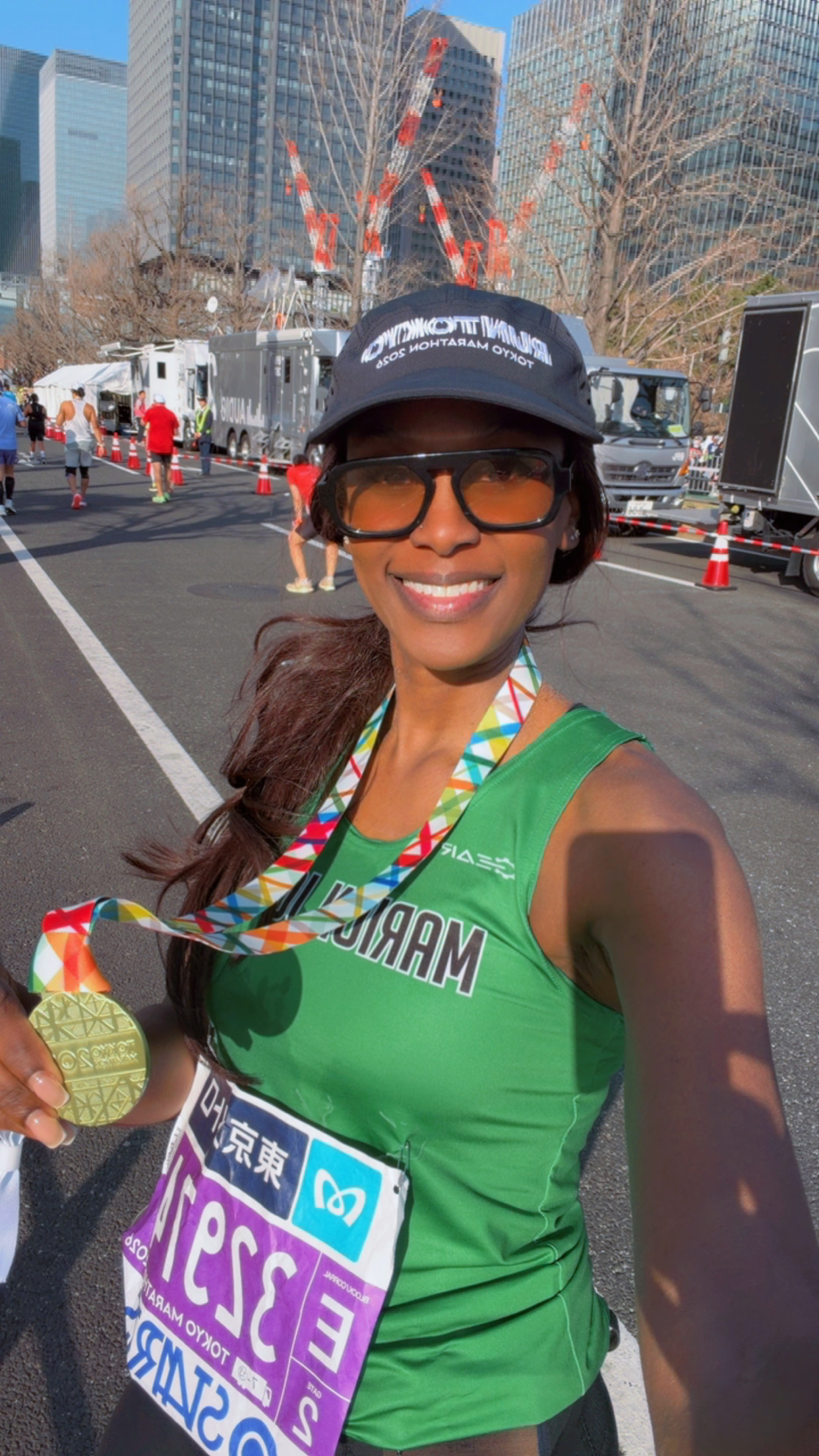
“I was in Tokyo for vacation in March 2023 when the Tokyo Marathon was taking place,” she said. “I was still getting adjusted to this new body and was inspired by the runners I saw. When I got back to the States, I decided I was going to train. A friend told me that I could run a marathon come fall if I started training now. I didn’t believe her, but she was right.”
She is now chasing the last of six stars in the Abbott World Marathon Majors, which features the world’s six largest marathons. In what she calls a series of full-circle moments, she completed the Tokyo Marathon on March 1 and will be running the Boston Marathon in April.
“I wasn’t just going to learn how to walk again,” she said. “I told myself, ‘I’m going to run again.’ And I am. I just completed my sixth marathon in Tokyo, and I’ll officially be named an Abbott World Marathon Majors Six Star Finisher in Boston. I can’t wait.”
Jones’ infusions — now spaced every eight weeks, which is a dramatic improvement from the biweekly schedule she once required — have become a familiar rhythm.
“When I walk in for my infusions, they say, ‘The runner has arrived!’” Jones said. “They ask about marathon training. They talk to me about everyday things. It’s the humanity. That’s what makes the difference. It’s more than lifesaving medication. It’s medicine for the soul.”
Bhatia agrees.
“Nurses see you in the most vulnerable moments, and they show up for you,” she said. “They made me feel safe at every turn. Rush’s nurses are the heart of the experience.”
Bhatia, now living in Asheville, North Carolina, after her pandemic-delayed wedding, returns to Chicago twice a year for her infusions.
“I could go anywhere, but I have no desire to go anywhere else,” she said. “Rush is where I feel safe. It’s where I feel cared for.”
Together, their stories show what happens when expertise and compassion converge.
For Jones, being understood matters deeply. A recent media mix-up further underscored why telling her story accurately matters. After an article mistakenly attributed Jones’ NMO diagnosis to Olympic sprinter Marion Jones, she realized how easily awareness can be diluted. For years, she would casually clarify that she was not the track star but the marathoner. When the mix-up involved her diagnosis, it felt different.
“I run these marathons to bring attention to this disease,” Jones said. “It diminishes the awareness when people think it’s someone else’s story. It’s hard to run a marathon, and I’m out here doing it with NMO thanks to Rush. Rush helped give me my life back.”
“And it changed mine,” Bhatia added. “This experience has made me a better doctor, a better patient and a more grounded human being.”


