


How to Become a Living Donor
The first step is contacting the Rush transplant team. Contact us to find out more.
The Rush Approach to Living Kidney Donor Transplant Services
At Rush, our living donor kidney transplant program has been giving patients a new beginning for more than 50 years. We work with donors and recipients alike.
We want donors and recipients to have a team they trust at every step of the process — and we have one of the top organ transplant programs in Chicago. We’re recognized as a “Donor Care Network Center of Excellence,” by the National Kidney Registry.
Millions of Americans are affected by kidney disease. Not everyone with kidney disease will experience kidney failure, but those who do have two treatment options: dialysis or kidney transplant.
Living kidney donation is an opportunity to share one of your two functional kidneys. A kidney from a living donor transplant typically lasts longer and has better outcomes.
 Meet our living kidney donor transplant doctors and providers
Rush Donation Process
After contacting the transplant center, you’ll be contacted by our independent living donor advocate. This person is dedicated to the donor and the donor alone. They are there to ensure it is in your best interests to be a donor. This person will be by your side through the entire evaluation and donation process.
You will have an appointment at our transplant center for a day of testing and screening. This will include blood tests, chest x-ray, CT scan and other diagnostic testing. At this appointment, you will meet with our team of transplant experts who will work closely with you throughout the process, including the transplant surgeon, transplant nephrologist (kidney specialist), registered dietician and a social worker.
The goal of the donor evaluation process is to minimize the harm to you and maximize your gift.
A Kidney to Save My Sister

Rush Excellence in Living Donor Kidney Transplants
- Exceeding expectations and outcomes: The Rush Living Donor Kidney Program has among the best one-year living donor kidney transplant patient survival rates in the Chicago area, according to the Scientific Registry of Transplant Recipients.
- Top-ranking program: Our living kidney donor transplant program has been recognized as a “Donor Care Network Center of Excellence,” by the National Kidney Registry.
- Expertise in minimally invasive surgery: Our living donor transplant procedures are done with a minimally invasive technique, including the use of laparoscopic and robotic tools. This allows for a faster recovery, less pain and quicker return to normal activity.
- Paired exchange program: Rush participates in multiple national paired kidney exchange programs. Through these programs, we help find the best match for donor and recipient pairs.
Living Donor FAQs
Please contact our team or call (312) 947-4438 to learn more about living kidney donation. We complete a health question screening with you over the phone. A thorough medical assessment will be done to ensure you are an appropriate candidate for donation.
To be a living donor, you must:
- Be over age 18
- Be in good health, both physically and emotionally
- Undergo a thorough evaluation process
- Understand and accept the surgery and its risks, including medical, psychosocial and financial implications - Understand and accept that the outcome of the transplant might not be as expected
- Be able tell the team clearly your reasons for donating once you are aware of all of the benefits and risks
You can give a kidney without having anyone in mind. This is called non-directed donation. Contact us to learn more and get started.
If you’re not a match for your intended recipient, you can join a paired kidney exchange program. This matches you with another donor-recipient pair, so each recipient gets a kidney that matches. The Rush Living Donor Kidney Program is part of a national exchange program. This expands the pool of donors and recipients.
The recipient’s insurance covers the cost of the medical tests you take as part of the evaluation process and surgery. Please speak with a member of our team to better understand more about the exact costs to plan for. Our team of experts can connect you with resources to cover the cost of travel or reimburse lost wages.
Most people live a normal, healthy life with one kidney. You’ll have yearly check-ups to make sure your remaining kidney is working well. If you are approved to donate, our team is confident to the best of our ability that you are healthy enough to donate with no long-term issues.
- Screening: If you’re interested in living donation, we start with basic health questions to see if donation is right for you.
- Evaluation: You’ll have a variety of tests (including blood, urine, and imaging) and meet with experts to learn about organ donation and what life after donation is like.
- Review: Our team will review your test results and may ask for additional information if needed.
- Approval: Our team will review your case. We will look at your results with our multidisciplinary team to make sure you’re healthy enough to donate.
- Your Decision: At any point in the process for living kidney donation, you can choose not to donate, for any reason. We protect your privacy and your decision.
- Scheduling Surgery: If you decide to donate, our team will schedule the surgery. For paired donations, surgery waits until a match is found.
- Surgery: Our surgeries are done in a minimally invasive technique, including using a surgical robot or laparoscopic tools. This means no big cuts — the surgery is performed with small holes, which means a shorter recovery time and fewer complications. The procedure lasts between 3 to 5 hours.
- Recovery: Expect one overnight stay in the hospital. When you return home, get lots of rest. Drink plenty of water after surgery. You will need a support system while you recover.
- Return to Normal: Most donors return to their normal life about four weeks after surgery. Our team will check in with you at six months, one year and two years post donation. We will monitor your blood pressure and kidney function. For the rest of your life, you will need yearly checkups with your primary care provider or family medicine doctor.
Based on your evaluation, you may not be approved to donate if your risk is too high. You may feel many emotions - that's normal. You can still support your recipient in many other ways by providing support companionship and driving assistance or meals.
Start by sharing your story with people — this could be family, friends, or even your wider community through social media.
It helps to know the facts: living donors can live a normal, healthy life with one kidney, and many people are healthy enough to donate. Anyone interested can learn more by contacting the Rush Living Donor Kidney Program or reviewing the resources linked in the sidebar on this webpage.
- Transplant surgeon: Performs your surgery and monitors your recovery.
- Transplant nephrologist: A kidney doctor who works with you before and after the transplant. They are responsible for monitoring your kidney and medical condition.
- Living donor coordinator: Your main point of contact who will guide you through the transplant process.
- Social worker: Offers emotional support and helps with financial and community resources.
- Psychiatrist/Psychologist: Helps you manage the emotional side of donation or transplant.
- Pharmacist: Reviews your current medications and explains the additional medications you’ll need after surgery.
- Independent living donor advocate: Ensures your rights and well-being are protected throughout the transplant process. You can discuss any concerns you have about your emotional well-being, finances, family, future employment or health.
- Registered dietitian: A resource for your nutritional status throughout the transplant evaluation and if recommended by our care team, can help with weight loss.
- Living donor facilitator: Explains the process, answer questions, offers insights, and provides education to you based on their own kidney donation experience.
- Directed donation: Donating to a specific person you're a match for.
- Non-directed donation: Donating to someone you do not know, often for personal or spiritual reasons. While you don’t choose the recipient, you must still be medically compatible.
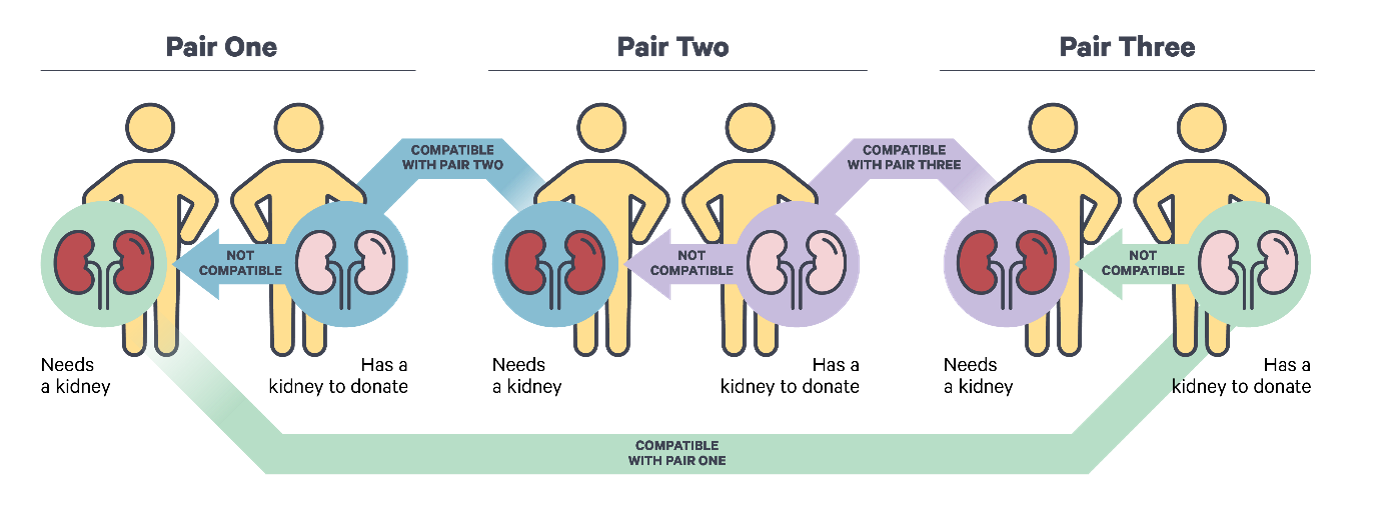
- Indirect donation: Using a paired exchange program, locally or nationally, to provide a living kidney donation for your intended recipient. Your donated kidney goes to someone in need, and in turn, your intended recipient receives a kidney from another matched donor.
If you are not a medical match for your intended recipient, a kidney swap allows you to donate and your intended recipient to get a healthy kidney. In this case, the donor and recipient can participate in an exchange program with another willing donor and recipient pair. Through the exchange, the recipients receive kidneys from compatible donors.
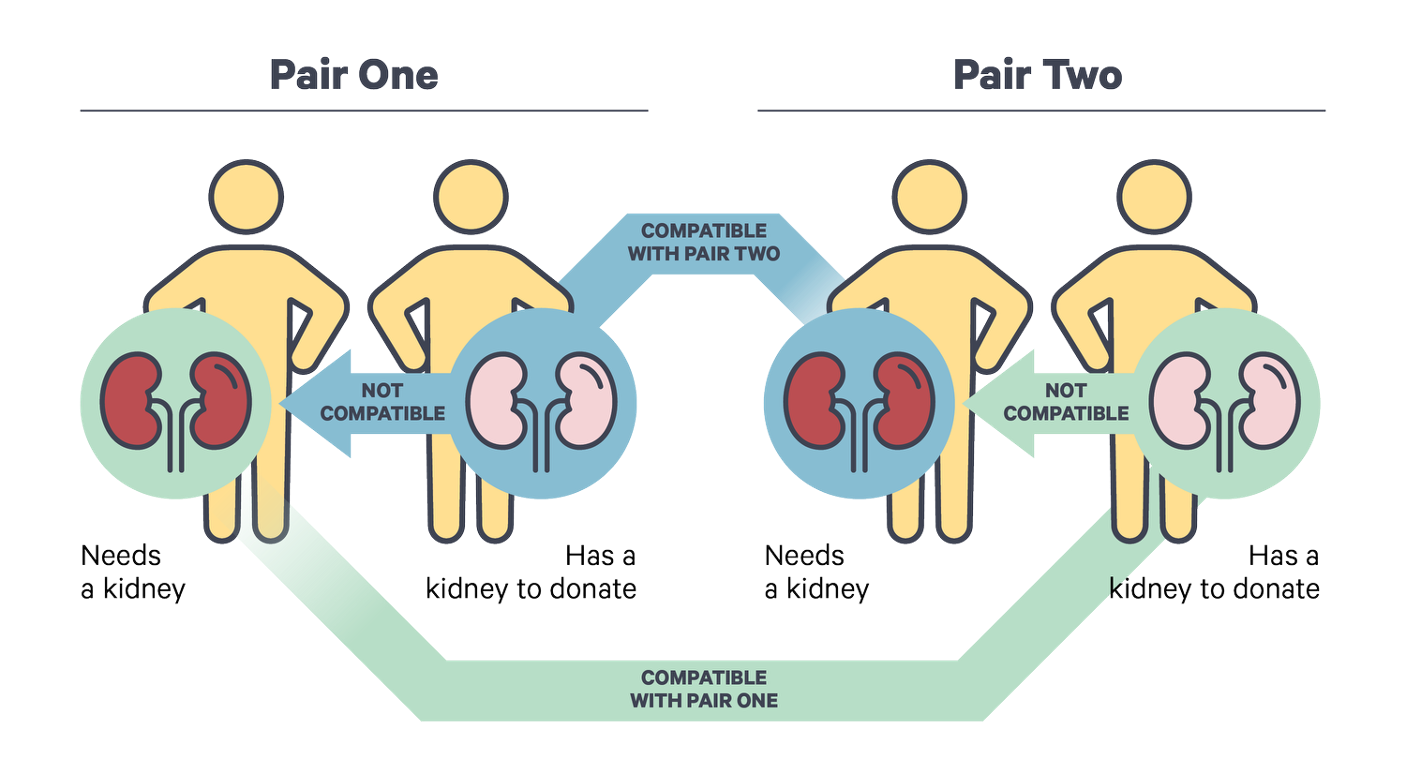
Similar to a kidney swap, a kidney chain occurs when more than two pairs of donors and their intended recipients are not a match with one another, but are compatible with other individuals. By donating organs to medically compatible individuals, each intended donor is able to donate an organ and each intended recipient is able to receive an organ transplant.
Your kidneys act as your body’s natural filters, removing waste and extra fluid from your blood. Waste and fluid are disposed of through urine. This helps keep your body in balance. When kidneys stop working properly, dialysis (using a machine to clean your blood) helps keep you healthy. A kidney transplant also restores this important function.
When kidneys stop working — a condition called end-stage renal disease — harmful toxins build up in the body. At that point, treatment is needed, either through dialysis or a kidney transplant. A transplant provides the recipient with a healthy kidney from a donor, helping the body filter blood again and improving quality of life.
Dialysis is a treatment that takes over when the kidneys can’t filter waste from the blood. Hemodialysis uses a machine to clean the blood outside the body. Peritoneal dialysis uses fluid in the abdomen to clean blood inside the body. Both help keep the blood free of waste and toxins and keep you healthy.