

Consistently delivering high-quality patient experience is fundamental to effective, patient-centered care. In today’s increasingly integrated and complex care environment, achieving scalable and sustainable best practices are essential to drive system-wide engagement, accountability and measurable outcomes.
This initiative focused on strengthening communication between registered nurses and medical assistants, or RN/MA Communication, a key driver of patient trust responsiveness and experience. The goal was clear: improve communication scores above the Press Ganey benchmark of 95.0 by identifying gaps, standardizing practice and embedding accountability into daily workflows.
Understanding the Opportunity
At the start of this project, overall RN/MA Communication scores were 94.9, just below the benchmark. This initiative began with a crosswalk of evidence-based interventions, education and training specific to patient experience at each location to gain a better understanding of the current state. While performance was strong, initial data revealed significant variability in workflows across sites with no defined guiding how messages were received, responded to and escalated. This variability created uneven patient experiences, highlighting the need for a unified approach.
A Three-Pronged Strategy for Sustainable Change
To close these gaps, the following three-pronged approach, focusing on awareness, technology and accountability was used:
- Building awareness and education
- The initiative began with the implementation of a Patient Experience Awareness Campaign, inclusive of staff training and engagement.
- To supplement this work, a Standard Operating Procedure, or SOP, was created. The SOP established a framework and set parameters to guide patient communication response timeliness and escalation process.
- Leveraging technology to improve responsiveness
- In collaboration with Epic teams, new electronic medical record, or EMR, capabilities were built to allow more seamless communication. RNs and MAs gained the ability to forward a message to a provider while simultaneously responding to the patient that the message has been received and was being addressed by the care team.
- Creating accountability through real-time data
- A central component of this strategy was the use of real-time technology platforms that provide patient experience data at both the provider and clinic levels.
- Custom dashboards were developed to present actionable metrics to clinical and operational leaders. These tools were integrated into existing workflows, making patient experience data a routine part of clinical performance reviews and operational discussions.
- To reinforce accountability, weekly leadership forums were launched to review performance trends, celebrate wins and address areas of concern. Clinics used their data to develop targeted action plans tailored to their unique data profile.
- Interventions included staff training on empathy and communication, redesigned workflows for patient check-in and discharge, and enhanced care coordination for complex cases.
- Patient experience metrics were also embedded into performance evaluations and quality dashboards, fostering a culture of shared responsibility.
- Coaching was provided for underperforming teams, while high-performing clinics were recognized and engaged to share best practices across the system.
Measurable Results and Lasting Impact
Over a seven-month period, patient experience scores steadily improved across all clinics, with the group average surpassing the 95.0 benchmark and sustaining that level for two consecutive quarters.
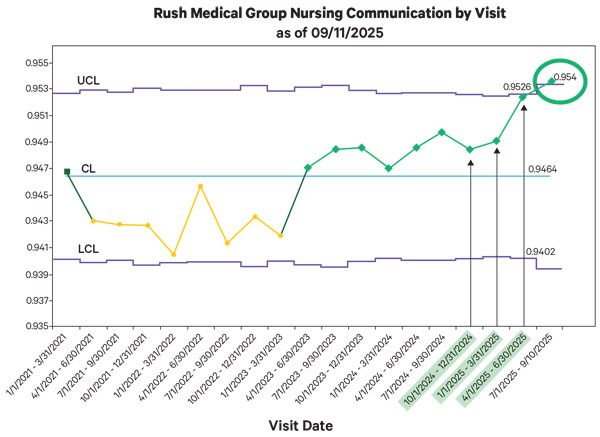
Notably, RN/MA Communication scores increased by 0.5%, a significant achievement given the high-volume outpatient setting where incremental gains and limited margins for improvement are difficult to achieve. By the close of the fiscal year, RN/MA Communication scores nearly surpassed the Upper Control Limit, underscoring the value of a structured, data-driven approach to improving patient experience.
A Replicable Model for Excellence
This initiative demonstrates the power of data, frontline engagement and standardized best practices to drive meaningful improvement in patient experience. By embedding communication standards into technology, workflows and accountability, a sustainable framework was created that other health systems seeking to embed patient experience as a core quality domain can be replicated.
Future efforts will focus on refining interventions, scaling new service lines and further leveraging technology to advance patient-centered innovation — ensuring that patient experience remains a core pillar of quality and operational excellence.