
An Evolving Therapeutic Landscape in Multiple Sclerosis Care

By Augusto Miravalle, MD

Multiple sclerosis is a chronic, immune-mediated disease of the central nervous system characterized by inflammation, demyelination and neurodegeneration. It often strikes in the prime of life, leading to relapses, disability and a substantial impact on quality of life.

At Rush, the future of MS care is being reshaped with advanced disease-modifying therapies and through the integration of cutting-edge imaging analytics. Icometrix, one of these AI-powered platforms, transforms routine clinical MRIs into quantitative measures of brain health, bringing unprecedented precision to how clinicians detect and track disease progression.
A New Era of Treatment and Monitoring

Over the past two decades, disease-modifying therapies have revolutionized the management of MS. These therapies suppress inflammatory activity, reduce relapse rates and slow disability accumulation. Rush offers the full spectrum of these treatments, including infusion therapies among the most effective worldwide, delivered in a safe, supportive environment at our infusion center.

Despite these therapeutic advances, one of the greatest challenges remains progression, particularly disability worsening that occurs independent of relapses — known as progression independent of relapse activity. Addressing this silent component of MS is now central to both research and clinical practice.

Why Measuring SELs and Brain Atrophy Matters

Emerging biomarkers such as slowly expanding lesions (SELs) and brain atrophy provide crucial insight into smoldering inflammation and neurodegeneration. SELs are chronic lesions that enlarge gradually over time, often accompanied by darkening on T1-weighted images, signs of ongoing tissue damage. Brain atrophy, or the loss of brain volume, correlates strongly with long-term disability.

However, these processes frequently go undetected on conventional MRI, which focuses on new or enhancing lesions. Quantifying SELs and atrophy requires advanced imaging analytics, which is something Icometrix’s icobrain MS now makes practical in everyday clinical care.

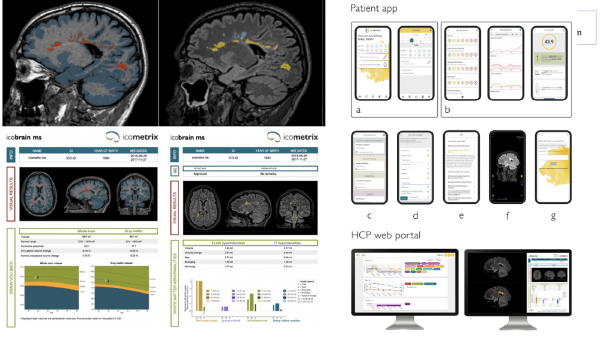
On the left is an example of an Icometrix quantitative MRI report illustrating volumetric brain measures provided to patients with multiple sclerosis. On the right is a screenshot of the icobrain/iCompanion app interface, which allows patients to track symptoms, record clinical data, and share relevant health information with their MS care team between clinic visits.

Rush: A Regional Leader in Advanced Imaging

Rush is the only center in the region offering Icometrix technology capable of quantifying SELs, brain atrophy and overall disease burden directly from standard MRI scans. Using artificial intelligence and sophisticated image processing, icobrain MS generates reliable, standardized metrics that extend far beyond traditional radiology reads. Clinicians can visualize brain volume loss, detect subtle lesion expansion, and assess smoldering disease activity — all from the same images already acquired for routine monitoring.

Transforming MS Care with Icometrix

By incorporating Icometrix into our MS program, Rush is closing the gap between research-grade imaging and clinical decision-making. This integration allows earlier detection of progression, more precise risk stratification and individualized treatment planning.

These capabilities also position Rush at the forefront of MS research, where SELs, brain atrophy and related imaging biomarkers are increasingly used as endpoints in trials targeting progression. Ultimately, Icometrix empowers clinicians to act on what was once invisible, turning advanced neuroimaging into actionable data that directly improves patient care.

Meet the Author

Augusto Miravalle, MD

Augusto Miravalle, MD

Neurology Request an Appointment